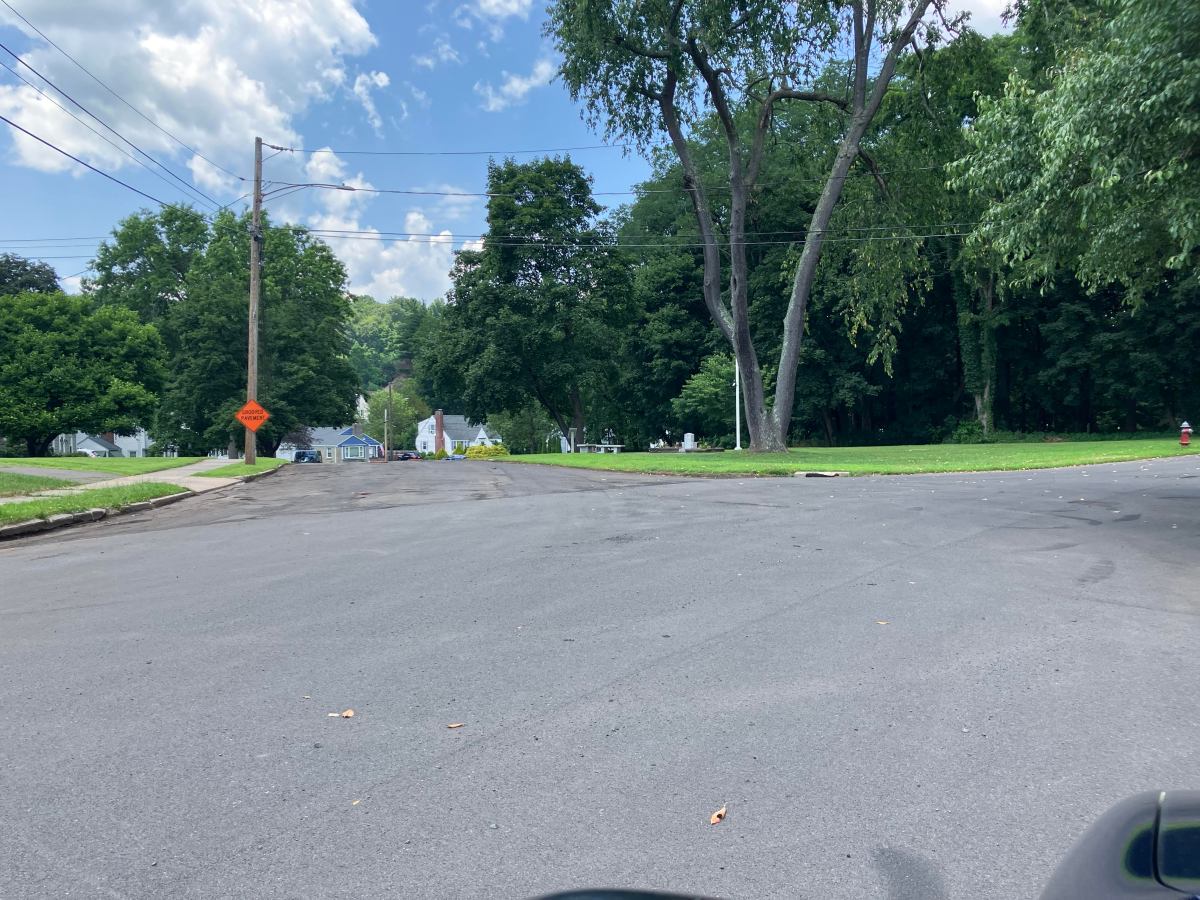
City Seeks $5 Million Grant for Allen Street Stormwater Project

from http://nbpoliticus.com — Publication date February 22, 2026

City officials confirmed last week they are seeking a major grant to close the gap in the funding of the Allen Street Utility-Road Phase II project where flooding and sewage overflows have caused problems in the neighborhood for decades.

The regional Local Transportation Capital Improvement Program (LOTCIP) received the New Britain application for $5 million to add to state and local funds already identified for implementation, Mayor Bobby Sanchez said.

On January 21st, Sanchez and Public Works Director Mark Moriarty held a meeting to update residents and Ward 4 alderpersons with a new plan to finance the project that included the LOTCIP grant program that is funneled to towns through the Capitol Region Council of Governments.

New Britain and other communities receive annual LOTCIP entitlement funds in local aid packages to make street and infrastructure improvements, including the street paving program. The grant for Allen Street would be over and above the regular allocation that totaled $1,515,489 in 2025. The CRCOG-LOTCIP program entertains larger projects in the central CT area.

The project encompasses 3,500 feet of roadway improvements and utility upgrades from Oak Street down to Beacon Street on Allen Street. According to the plan developed for the city by Cardinal Engineering, an existing 24-inch storm drainage pipe will be replaced with new piping ranging in size from 48 to 66 inches. The existing 12-inch sanitary pipe will be replaced with a 24-inch pipe and a water main will also be replaced. Roadway reconstruction will include new curbing, sidewalks and driveway aprons in the project area.
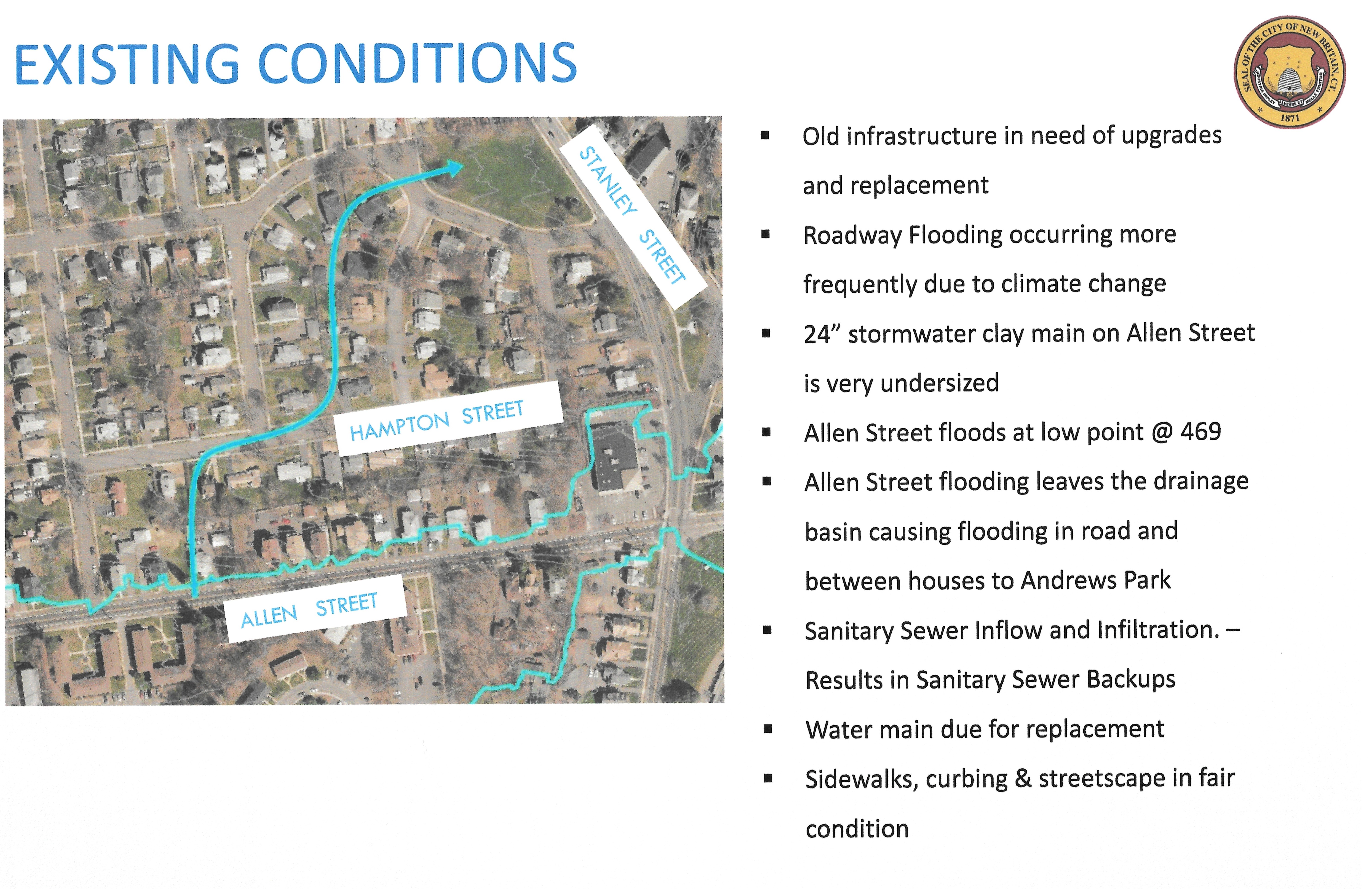
Existing conditions on Allen Street between Oak and Stanley streets. (Dept. of Public Works)

Since the summer of 2023 a dramatic jump in flooding from extreme weather led to a public outcry in New Britain, especially from residents in the Overlook Avenue-McKinley Drive and Allen Street neighborhoods. The public pressure eventually led to new plans and capital funding for Allen and Overlook where extensive damage occurs. The city addressed flooding at Overlook and McKinley, a $2 million project, with remaining federal American Rescue Act funds last year.

Roxbury Road resident Frank Chase, hit hard by flooding to his home, has led efforts to secure infrastructure funding and mobilize support for project implementation.

City officials are counting on the $5 million CRCOG-LOTCIP grant request to be the catalyst for project implementation. The financial plan introduced in January seeks to raise $18 million in local, state and federal funding. Other sources of funding either committed or sought include:

  • $6 million in local funding committed to date
  • $2 million from CT Urban Action Grant from state bond commission to date (2025)
  • $960,000 US EPA State Bond Request with $239,938 local share
  • $4 million water infrastructure federal funding application.

John McNamara is a Ward 4 Alderman and the Common Council Majority Leader.
City Audit for FY 2025 Finalized on Time

The completion of the 2025 municipal audit on time is welcome news before the Mayor and Common Council begin preparing a budget for the year that begins on July 1st. — John McNamara

Independent auditors delivered New Britain’s financial statements for the year ending June 30, 2025 to city officials and the state Office of Policy and Management ahead of a December 31st deadline after several years of the reports being filed late.

Material weaknesses and noncompliance found in prior years have been corrected, according to the CliftonLarsonAllen (CLA), the city’s auditing firm. Auditors found one remaining deficiency in “internal control over financial reporting” that was attributed to “a shortage in staffing.” Recommended in CLA’s Single Audit Report is a formal financial close process “to ensure each fund’s year-end balances are analyzed timely and corrected appropriately.”

Municipalities are expected to complete annual audits by December 31, six months after the close of the fiscal year. Last year’s audit came on March 31.

The audit examined the municipal budget of $269.5 million that set a property tax rate of 39.59 mills for the July 1, 2024-June 30, 2025 year. The tax collection rate “remained steady” at 96.33%.

The Financial Statements for Fiscal Year 2025 show general fund revenue increases of $11.1 million from a 1.31 mill rate increase adding $2.8 million, $4 million in additional earnings from interest income, $2.9 million in reimbursements for completed state-funded projects and a $1.4 million increase in police special duty funds from delinquent payments that were received in 2025.

Overall revenues for 2025 totaled $455.8 million including property taxes accounting for 34%, 51% from state and federal grants and external contributions and the balance from other sources.

The audit reported $295.7 million of long-term debt in bonds and outstanding notes, a decrease from $307.6 million in the previous year. The city’s long-term indebtedness for all government activities based on the city’s net position totals $626.374 million. As of last June 30th, fund balances increased to $40.56 million with $14 million in assigned and $26.5 million in unassigned balances.

In their management discussion, auditors discussed the current municipal budget set at $273,493,952, $3.8 million more than 2025. The mill rate dropped this year to 39.18 that was attributed to “a slight increase in property values and the use of $6.7 million in tax stabilization funding.”

The budget process for the 2027 fiscal year begins this month when the Board of Finance and Taxation receives estimates from the Board of Education and city departments.

This post originally published at http://nbpoliticus.com

Task Force Hearing On Traffic Cameras Scheduled for Thursday, January 15th

by John McNamara

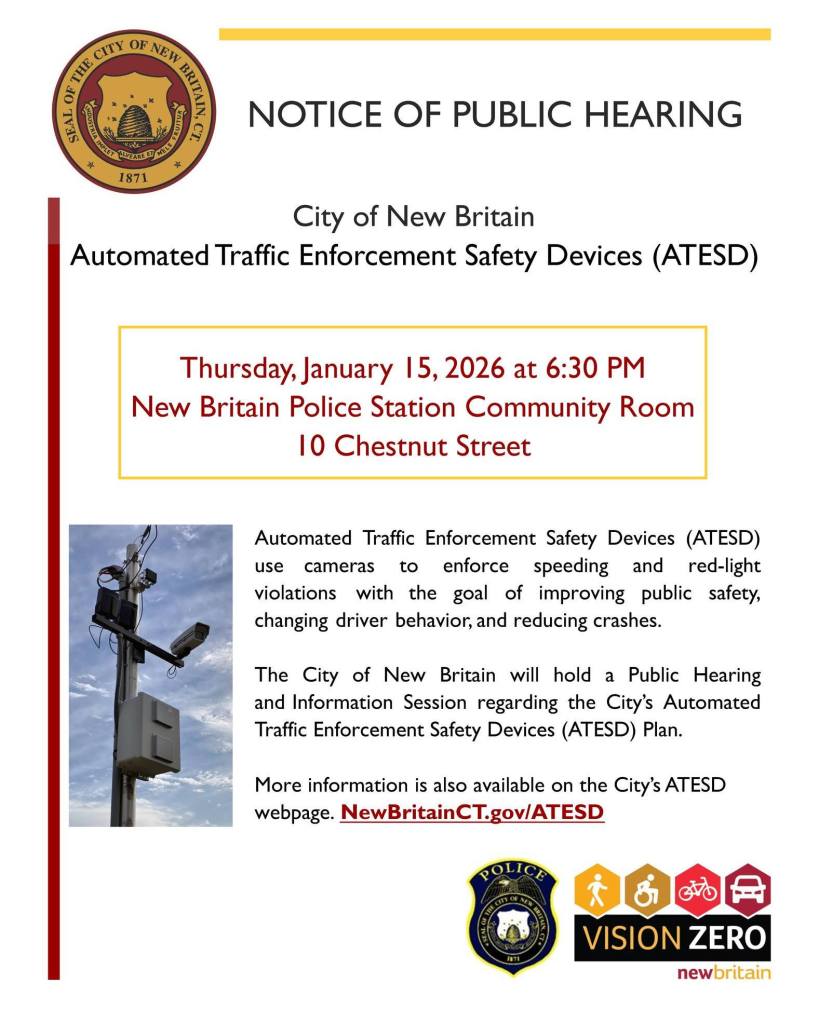
The City of New Britain will take the next step in selecting locations for speed enforcement traffic cameras at a January 15th public hearing of the Vision Zero Task Force.

A Vision Zero public hearing is set for Thursday, Jan. 15th, at 6:30 p.m. at the New Britain Police Department Community Room, 10 Chestnut Street.

In 2025 the task force, comprised of elected and appointed city officials, developed the Traffic Safety Action Plan working with consultants from Cambridge Systematics. Federal grant funds from the Capitol Region Council of Governments (CRCOG) have supported Vision Zero initiatives in central Connecticut towns over the last year.

The Common Council adopted a resolution that established the task force “to develop a comprehensive Safety Action Plan to identify projects and strategies that will reduce fatalities and serious injuries at high crash locations in New Britain.”

The 57-page report provides a range of “countermeasures” to “reduce fatal and serious injury crashes by 50% by 2035 and to reach Vision Zero by 2045.” One of the “key findings” is to “leverage technology to mitigate safety challenges….by employing ATESD location designation, street lighting and signal turning changes.”

Last June the Common Council adopted a new ordinance to allow the use of automated traffic enforcement safety devices (ATESD) under a state law (Public Act 23-116) enabling communities to use the video technology as part of safety action plans.

ATESDs in New Britain will be used to automatically detect and record traffic violations, such as running a red light, speeding, or other infractions. State law allows municipalities to establish a fine to be imposed against the owner of a motor vehicle committing a violation of not more than $50 for a first violation and not more than $75 for a second or subsequent violation. Local officials have stated that initial violations will result in a warning and not a fine with a purpose of changing behaviors more than collecting revenue. “Any funds received by a municipality from fines imposed shall be used for the purposes of improving transportation mobility, investing in transportation infrastructure improvements or paying the costs associated with the use of automated traffic enforcement safety devices in the municipality.”

Altumint, Inc., a Maryland-based company that manufactures and supports ATESD systems, was selected as the vendor for license plate recognition devices. Altumint, a CRCOG approved vendor, has been selected by several CT communities for implementation.

Any contract with Altumint is expected to be “cost neutral” according to the company. In responding to the city’s request for proposals Altumint stated “tax dollars will never be used to pay for this technology. Our invoicing over the life of the contract for your ATESD program will never exceed the Town’s fine revenue collected.”

Concerns have been raised over rights and personal privacy in regard the use of “flock” surveillance cameras that collect more data than specialized license plate readers that are proposed for New Britain. In December the American Civil Liberties Union called for a moratorium on “flock” surveillance in the state, according to a CT News Junkie story.

The ATESDs are limited to a maximum of two in a census tract to avoid targeting. For privacy concerns information collected cannot be used for other purposes, the driver and passengers are not identifiable and all personal information must be deleted in 30 days, according to the state enabling legislation that says “no personally identifiable information shall be disclosed by the municipality or a vendor to any person or entity, including any law enforcement unit, except where the disclosure is made in connection with the charging, collection and enforcement of the fines imposed.” Violations will be under local control with alleged violations reported electronically to the New Britain Police Department.

The starting point for camera implementation will involve 17 “school zones” especially for children walking within a half mile of school. The plan, however, includes lists of priority intersections and high crash locations throughout the city with possible countermeasures. More than 20 locations, for example, are identified in extended downtown area with “the most pedestrian/cycle crashes” call for stepped up enforcement.

Data from the University of Connecticut’s Crash Data Repository has been used to identify trouble spots. The UCONN data shows there were 17 fatalities involving 127 vehicles in New Britain over three years (October 2021-September 2024) and 90 persons with suspected serious injuries involving 141 vehicles in the city over the same period. For all crashes and collisions 5,230 were reported involving 9,607 vehicles between 2021 and 2024.

New Britain’s implementation and enforcement is expected to be similar to Middletown where the the city approved AETSDs in late 2024.

Following public hearings and Common Council approval the city will submit a plan to the CT Department of Transportation (CT-DOT) that will identify the locations of the cameras.

 Vision Zero  as a public policy originated in Sweden in 1997. Its “core principle” is that “it can never be ethically acceptable that people are killed or seriously injured when moving within the road transport system.” It has spread to other countries including cities and towns in the United States. The federal Safe Streets grants program, part of the Infrastructure and Jobs Act adopted in 2021, is accelerating Vision Zero initiatives in the U.S.

John McNamara is an alderman from Ward 4 and the Common Council Majority Leader.
Related post from December 2024 https://nbpoliticus.com/2024/12/12/vision-zero-task-force-sets-goals-to-reduce-traffic-fatalities/

Council Democrats Question Use of $470K For Pickle Ball Courts In Budget Transfer

NEW BRITAIN – Common Council Democrats are questioning the use of $470,000 to fund construction of pickle ball courts at A.W. Stanley Park in a budget transfer resolution to be considered at the September 24th regular meeting of the Common Council.

Common Council Democrats Update

The resolution proposes to transfer accrued revenues from the 2024-2025 fiscal year to the current budget to fund projects and purchases not covered in the current year budget totaling $5,858,459. Funding for pickle ball courts is one of nine proposed expenditures as well as the transfer of funds to “fix deficits” and align revenues and expenditures on the city’s ledger before an independent audit for the year ending June 30,2025 begins.

“We welcome the availability of unaudited fund balances from the last fiscal year to allocate funds for the Board of Education, tax stabilization and needed capital improvements,” Council President Francisco Santiago (D-5), Assistant Majority Leader Iris Sanchez (D-3) and Majority Leader John McNamara (D-4) said in a joint statement. “The city, however, should use these general fund dollars to meet more urgent priorities other than the addition of more pickle ball courts at this time.”

Earlier this year the city administration sought $150,000 in Community Development Block Grant (CDBG) funds for the A.W. Stanley Pickle Ball Court Project in a request that also proposed use of $300,000 from the A.W. Stanley Trust Fund at an estimated cost of $450,000. The plan would construct four pickle ball courts and a tennis court at the park that currently provides swimming pools, little league fields, a playground, walking trails and a fishing pond. The Common Council, however, allocated funds to other capital improvement projects as part of the annual plan to the U.S. Department of Housing and Urban Development (HUD).

Democratic Council leaders said alternatives should be considered for using the $470,000 “that meet compelling needs in the community to prevent evictions, reduce food insecurity and improve streets and infrastructure in our neighborhoods.”

“Now we are facing federal funding cuts and harmful policies from Donald Trump and the Republican Congress. Grants for community health and immunization programs have been jeopardized, Nearly $1.5 million in federal education funds were held up creating uncertainty before the school year began. An estimated 7,000 New Britain residents will lose Medicaid benefits once the Republican “big, beautiful bill” that slashes the social safety net and cuts taxes for billionaires takes effect,” the Democratic caucus statement said.

“Spending with our limited resources should go to essential services and investments that directly improve the health and well-being of residents,” said Alderwoman Wilma Barbosa (D-2), who serves on the Council’s Administration, Finance, Law and Public Services Committee.

The Common Council meeting will be held at New Britain City Hall, 27 West Main Street on Wednesday, September 24th. Public participation begins at 7 p.m.

Democratic Municipal Officials Group Endorses Ward 4 Alderman McNamara

Ward 4 Alderman John McNamara has been endorsed by an organization of Democratic elected officials in his bid for a second term on the New Britain Common Council.

The Democratic Municipal Officials Organization (DMO) endorsed McNamara who is serving his first term on the Common Council and serves as Majority Leader.

DMO is a national association of elected Mayors, City Council Members, School Board Members, and other municipal leaders “who identify with the values of the Democratic Party.” It serves to “to connect, elect, and empower municipal elected officials by leveraging its national network of members, alumni, and strategic partners.”

McNamara and former Alderwoman At Large Luz Ortiz-Luna are the endorsed Democrats in the September 9th Democratic Primary in Ward 4 that includes District 12, 13 and 14. In 2023 the city changed the composition of the Common Council from a hybrid system of five at large members and two members from each of the five wards to three alderpersons in each of the wards. Parties nominate two candidates to appear on November’s ballot under the minority representation law.

McNamara welcomed the DMO endorsement saying “New Britain and municipal governments across the country are addressing aging infrastructures, the need for affordable housing and school funding issues. We face funding cuts and harmful policies from a Republican administration and Congress. DMO is a resource in these uncertain times to exchange ideas and solutions with other elected officials in the effort to sustain and build healthy communities.” McNamara participated in a DMO Leadership Council last year at the Democratic National Convention and served as a Connecticut ambassador for the organization.

In seeking a second term on the Common Council, McNamara cited his key priorities for city government over the next two years that include affordable housing and fair taxes, neighborhood flood relief, equitable funding for schools and safer streets.

SEE McNamara Cites Key Priorities in Bid for Second Term

Holmes School Renovation Is on Schedule for Fall 2026 Re-Opening

A $70 million comprehensive renovation of the Stanley H. Holmes Elementary School on Stanley Street near A.W. Stanley Park is on schedule for re-opening in the fall of 2026.

Members of the School Building Committee toured the school construction site on August 20th and heard from Construction Manager Kamil Musical of Newfield Construction that more than half of the rebuilding and expansion of the K-5, 460-pupil school is complete.

The project adds a courtyard linking the original structure and a new, two-story wing. Spaces for individualized learning and soundproof classrooms are part of the enhancements at the school constructed in 1956. The re-design will allow school busses to enter and exit from Stanley Street instead of using adjacent residential streets for traffic flow.

SBC members and school personnel toured Holmes School construction on August 20. Photo top right shows a new auditorium taking shape and at bottom left new space for the arts. At right is Ward 4 Alderman John McNamara who serves as council liaison to the SBC.

Newfield Construction reports that New Britain residents comprise 14 percent of project employees and 51% are from minority groups. Building trades union members make up the work force under prevailing wage agreements.

Ninety-five (95) percent of the costs for Holmes are being met by state school construction bonds. As work continues toward completion at the end of this school year, the city has received $9,858.059 in reimbursements thus far.

Through the efforts of the city’s legislative delegation, including State Rep. Robert “Bobby” Sanchez (D-25), a former Chair and current member of the Legislature’s Education Committee, state support for school construction in New Britain has exceeded 90 percent for the Holmes, Chamberlain and Smalley school renovations in recent years. State bonds for school construction generally meet up to 80 percent of capital costs in most cities and towns.

The John Paul II School on Farmington Avenue (formerly Holy Cross School) is housing Holmes’ staff and teachers through the end of the 2025-2026 School year. JPII School has been the temporary location for schools’ undergoing construction in recent years, including the Smalley and Chamberlain elementary schools in lease agreements with Holy Cross Church and the Archdiocese of Hartford.

A new, two-story wing of Holmes Elementary School under construction on August 20th.

The School Building Committee (SBC) meets Wednesdays on a monthly basis “to oversee school building projects authorized through bond funding as approved by the New Britain Common Council.”  The SBC is a key decision maker in terms of capital expenditures in city government. Once plans are approved by the Common Council and Board of Education, the SBC “engages, selects, and enters into or continues all necessary contracts with contractors, architects, landscape architects, or engineers, and within the limits of the appropriations made by the council. ” Angelo D’Alfonso is the current chairperson and Attorney Michael Carrier is Vice Chair.

This update provided by Alderman John McNamara

(Ward 4 Alderman and Common Council Majority Leader John McNamara is a Council Liaison to the School Building Committee)

Road Work Is Underway For Seven Streets in Ward 4 Near CCSU

The City’s Annual Milling & Paving Program is underway and seven Ward 4 streets in the vicinity of Central CT State University (CCSU) are scheduled for re-paving in July.

Ward 4 streets slated for work include Hillcrest Avenue, Kilbourne Avenue, Hazelmere Road, Sylvan Road, Sunnyslope Drive, Rosemary Lane and Fairway Drive. Overall 30 streets throughout the city are being upgraded including the Walnut Hill Park Loop Road. The milling and paving began on June 16 and will continue through July and a portion of August.

Residents with questions or who are looking for more information may visit the Department of Public Works Pavement Management Program for daily updates provided by Traffic Operations Manager Carl Gandja. Officials say the rehabilitation work involves milling two inches off the top of existing pavement and then installing two inches of new pavement.

Spending for the milling & paving program in 2025 totals $3,000,000. In May the Common Council authorized a $2,690,000 payment to Tilcon Connecticut, Inc. and $310,000 to Garrity Asphalt Reclaiming of Bloomfield for the purchase of bituminous concrete materials and installation on streets across the city. Selections were made through the state cooperative purchasing plan. The source of funds is from state road aid through the Local Capital Improvement Program (LoCIP) and the city’s 1% for roads program.

Sunnyslope Drive is one of seven streets in Ward 4 to be re-paved this summer.

For more information: John McNamara, 860-416-0665 Email john.mcnamara@newbritainct.gov

Traffic Safety Plan Will Include Roundabouts, Camera Enforcement Options

Safe Streets Report and Recommendations to Be Released June 25

By John McNamara

A final report of the city’s Vision Zero Task Force is expected to be released on June 25th with recommendations to reduce vehicular and pedestrian accidents throughout the city.

The Common Council took the first step of the Vision Zero initiative last December by adopting a Council resolution, introduced by Assistant Majority Leader Iris Sanchez (D-3), that accepted a $350,000 grant in federal transportation funds and established the task force “to develop a comprehensive Safety Action Plan to identify projects and strategies that will reduce fatalities and serious injuries at high crash locations in New Britain.” .

On June 11th the Common Council adopted a new ordinance to allow the use of automated traffic enforcement safety devices (ATESD) under a state law enabling communities to use the video technology as part of safety action plans. Unanimous approval came after Council Democrats requested and received confirmation of the local approval process and how the city will implement ATESDs at high-risk intersections.

Use of ATESDs will require public hearings, Common Council approval and state Department of Transportation (DOT) approvals for both local and state roads in the city.

The heavily traveled intersection at Corbin Avenue and Steele Street near Lincoln Elementary and Slade Middle School is in a school zone where automated camera placement will be considered. (NB Progressive photo)

Public Works Director Mark Moriarty and Traffic Operations Manager Carl Gandza told the Council that the primary goal of the devices “is not to catch or fine drivers but to change behavior.” They said the benefits can include reduced speeding and red-light running and “increased compliance” and reduced reliance on policy enforcement.” For equitable enforcement the ATESDs are limited to a maximum of two in a census tract to avoid targeting or profiling. For privacy concerns information collected cannot be used for other purposes, the driver and passengers are not identifiable and all personal information must be deleted in 30 days, according to Public Works officials.

Under the AETSD ordinance the camera collects the license ID only and a first-time warning is sent to the vehicle owner. Subsequent violations may result in fines but officials indicated that the cameras are not intended to raise significant revenue.

A roundabout traffic configuration is under consideration at the corner of Martin Luther King Boulevard and North Street where numerous accidents have occurred. (photo courtesy of Iris Sanchez)

As a starting point for camera implementation the task force has identified 17 “school zones” especially for children walking within a half mile of school. The plan, however, includes lists of priority intersections and high crash locations throughout the city with possible countermeasures. More than 20 locations, for example, are identified in extended downtown area with “the most pedestrian/cycle crashes” call for stepped up enforcement.

Specific infrastructure improvements are identified in two locations where re-designs such as roundabouts can reduce traffic flow risks. They include Martin Luther King Drive (CT-71) from East Main to North Stanley in Ward 3 and Corbin Ave from Hart to Chamberlain/Brookside streets in Ward 1.

The Vision Zero Task Force working with consultants from Cambridge Systematics has relied on data from the University of Connecticut’s Crash Data Repository to identify trouble spots. The UCONN data shows there were 17 fatalities involving 127 vehicles in New Britain over three years (October 2021-September 2024) and 90 persons with suspected serious injuries involving 141 vehicles in the city over the same period. For all crashes and collisions 5,230 were reported involving 9,607 vehicles between 2021 and 2024.

from http://nbpoliticus.com

Related post from December 2024 https://nbpoliticus.com/2024/12/12/vision-zero-task-force-sets-goals-to-reduce-traffic-fatalities/

John McNamara is an alderman from Ward 4 and the Common Council Majority Leader.
Traffic Safety Plan Will Include Roundabouts, Camera Enforcement Options – New Britain Progressive Newspaper

Council Democrats Dispute Mayor’s Veto of Fair and Balanced Budget

Amendment reduces tax rate and shifts funds to schools, the library and homeless prevention

A 2026 municipal general fund budget supported by Common Council Democrats that reduces the property tax rate and increases operational funds for schools, the library and homeless prevention was approved at the May 28th meeting.

On June 7th Mayor Stewart vetoed the Democratic amendment approved on an eight to seven party line vote. It will require 10 votes on the 15-member Council to override a Mayoral veto. 

The Democratic majority caucus and the Stewart administration agreed on a $273,493,952 million budget and a .41 cut to the mill rate (39.18 mills) for the fiscal year that begins July 1, but the mayor opposed additional operating funds for education, the library and a prevention fund for the unhoused.

New Britain City Hall, West Main Street

By waiting until June 7th, the mayor pocket vetoed the amended budget without a Council discussion or vote to override.

Statement from the Majority Caucus

“Our constituents want to see strong schools, access to literacy, and support for vulnerable residents. We delivered a budget that meets those needs without raising taxes.

“The amendment to the mayor’s budget included responsible reallocations from unfilled administrative positions and discretionary lines. No jobs were cut that would impact essential services. No union contracts were violated.

“The amendment supported a mill rate reduction of .41 after two years of major tax increases.  It provided a $1.1 million increase to the schools’ operating fund instead of withholding funding until the end of the year, providing more stability for the education budget. From reallocations and without new spending the public library receives $175,443 addressing its rapid growth and services for students, seniors and families. A $20,000 allocation funds unhoused prevention services that can help keep vulnerable residents in their homes.

“Contrary to the veto message, the amendment did not touch the city’s rainy-day fund (unassigned fund balance) of $25.1 million. The Democratic caucus, in fact supported adding to the rainy-day fund and creating a tax stabilization fund in the current term.

“It is unfortunate that the mayor’s veto included personal attacks and unfounded accusations that are inappropriate in doing the city’s business. The Council amendment addressing community needs passed after weeks of review and discussion.  The Democratic caucus is ready for collaboration and good faith negotiation on issues that matter to residents.

The Democratic caucus includes President Pro Tem Francisco Santiago (5), Majority Leader John McNamara (4), Assistant Majority Leader Iris Sanchez (3). Nate Simpson (1), Wilma Barbosa (2), Lori McAdam (2), Candyce Scott (3), Neil Connors (4).