Education Funding, Traffic/Safety Concerns Raised at Mayor’s Ward 4 Meeting

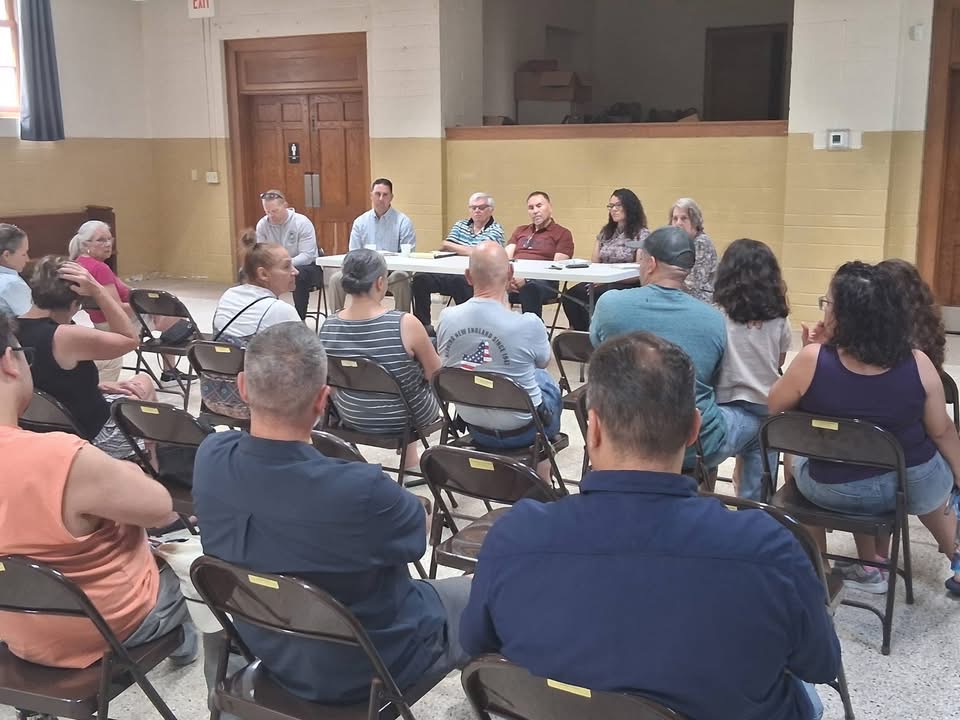
Mayor Bobby Sanchez took his first-year listening tour to Ward 4 on June 27 where residents shared concerns on speeding, traffic enforcement, public safety and support for schools in a wide-ranging, two-hour discussion.

The meeting held at Saint Francis Church Hall drew more than 30 persons with the mayor and other officials. Joining Sanchez were State Rep. David DeFronzo (D-25), Alderwoman Luz Otiz-Luna (D-4), Alderman John McNamara (D-4), Police Chief Matt Marino and Suzanne Bielinski, Chair of the city’s Police Commission.

Ward 4 Common Council Update – July 2026

Residents cited excessive speeding “day and night” on the roads, ignoring stop signs and groups of all-terrain vehicles (ATVs), dirt bikes and mini motorcycles. Mentioned as trouble spots were Carlton Street, Farmington Avenue, Country Club and Alexander Roads, among others, in Ward 4.

Mayor Sanchez and Chief Marino urged residents to contact the New Britain Police Department (NBPD) about incidents and “hot spots” that have been the subject of Common Council petitions. Officials said it is important to report when and where incidents are occurring. “You just have to keep letting us know,” said Chief Marino. “The more you call the more it helps,” said Rep. DeFronzo.

The NBPD Traffic Division may be reached at 860-826-3070 or by contacting Sgt. Adam Capowski, adam.capowski@newbritainct.gov. A new “community tip line” is also available for reporting crime information anonymously at 860-826-3199.

To reduce speeding the Sanchez Administration is moving ahead in two ways:

  • Removable speed humps will be introduced on a trial basis in city parks, according to Sanchez. “I would like to hear from the community where residents would like to see speed humps.” (Following the Ward 4 meeting Sanchez announced humps will get a tryout on park roads).
  • The City awaits CT Department of Transportation’s (DOT) approval to introduce ATESD traffic cameras (Automated Traffic Enforcement Safety Devices) in school zones as part of the Vision Zero Action Plan to reduce auto and pedestrian accidents. Last January, the Common Council adopted an automated camera implementation plan to submit to the state. Possible locations for speed enforcement cameras in Ward 4 include Alexander Road, Barbour Road, Blake Road and Farmington Avenue near Pulaski Middle School.

Sanchez agreed that more police officers are needed for enforcement throughout the city in response to questions on staffing levels at NBPD. Recent transfers and retirements require new hires this year and the application for entry-level patrol officers is currently available. Chief Marino said it takes just under a year for qualified candidates to join the force. The starting salary is $58,873 annually.

Chief Marino and Rep. DeFronzo, saying combining resources among schools and organizations can help, pointed to the value of school partnerships to engage middle- and high school students as part of juvenile diversion strategies. Extra-curricular activities will head off negative behaviors in and out of school, they said, citing programs such as ROOTS youth agriculture and nutrition program and police-led “new age” D.A.R.E. programs.

On the recently adopted municipal budget and support for education for the fiscal year that began July 1, Mayor Sanchez said his efforts with the city’s legislative delegation succeeded in New Britain obtaining a $13.3 million increase in state school aid to avert teacher layoffs and program cuts.

The municipal budget of $286,164,960 that holds the property tax mill rate at 39.18 includes the one-time $13.3 million in state school aid and $4.6 million in additional state aid to municipal government. The budget includes a $1 million increase in local school aid also known as the minimum basic requirement (MBR) and $450,000 more for schools in savings from the self-insurance fund. Over the last 12 years the MBR has for the most part been flat, a factor in New Britain’s low ranking in local aid that contributed to the growing funding gap this year.

To give public schools sustainable sources of funding and avert double-digit funding shortfalls, Sanchez and other officials said they will push for an increase in the state’s Educational Cost Sharing (ECS) formula that fell short in the budget adjustments made this year. The General Assembly is expected to take up a change in ECS grants to increase the current $11,525 per student allocation that has not been increased since 2013.

 Related Links for more information:

Vision Zero Traffic Safety Plan

New Britain Municipal Budget 2026-2027

New Britain Police website

State Representative David DeFronzo

Meeting Photo Credit: New Britain Mayor Bobby Sanchez

Alderwoman Luz Ortiz-Luna and Alderman John McNamara represent Ward 4 on the Common Council.

New Britain Common Council website

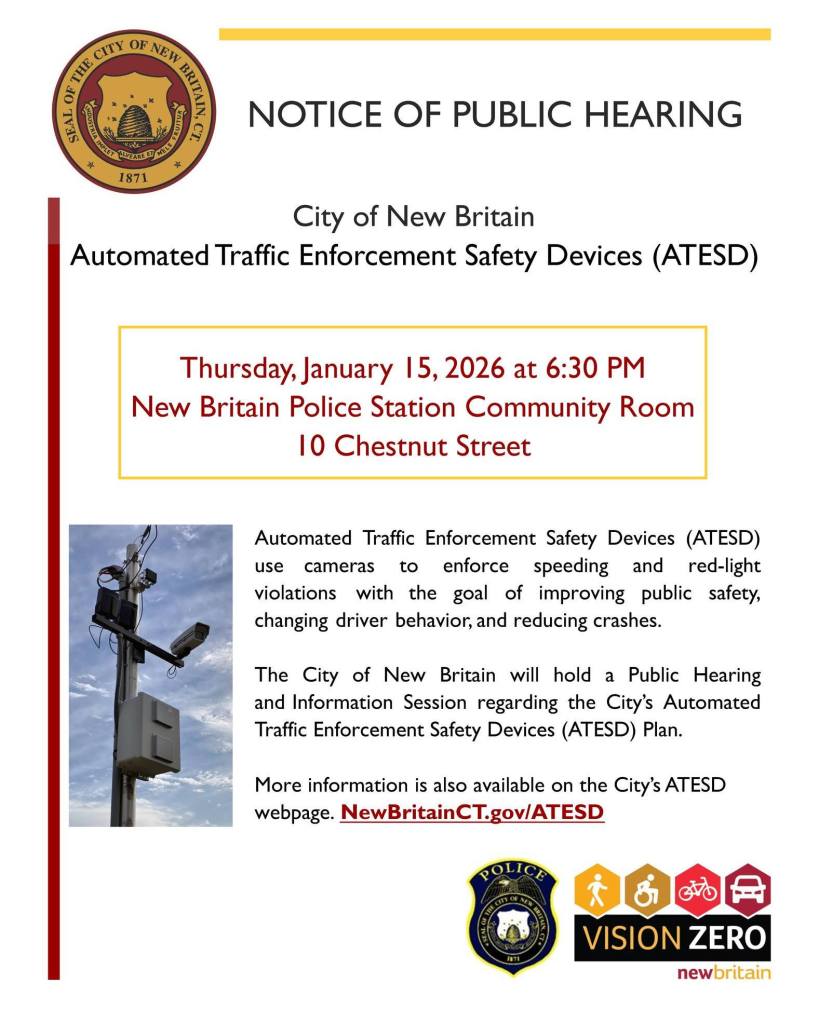
Task Force Hearing On Traffic Cameras Scheduled for Thursday, January 15th

by John McNamara

The City of New Britain will take the next step in selecting locations for speed enforcement traffic cameras at a January 15th public hearing of the Vision Zero Task Force.

A Vision Zero public hearing is set for Thursday, Jan. 15th, at 6:30 p.m. at the New Britain Police Department Community Room, 10 Chestnut Street.

In 2025 the task force, comprised of elected and appointed city officials, developed the Traffic Safety Action Plan working with consultants from Cambridge Systematics. Federal grant funds from the Capitol Region Council of Governments (CRCOG) have supported Vision Zero initiatives in central Connecticut towns over the last year.

The Common Council adopted a resolution that established the task force “to develop a comprehensive Safety Action Plan to identify projects and strategies that will reduce fatalities and serious injuries at high crash locations in New Britain.”

The 57-page report provides a range of “countermeasures” to “reduce fatal and serious injury crashes by 50% by 2035 and to reach Vision Zero by 2045.” One of the “key findings” is to “leverage technology to mitigate safety challenges….by employing ATESD location designation, street lighting and signal turning changes.”

Last June the Common Council adopted a new ordinance to allow the use of automated traffic enforcement safety devices (ATESD) under a state law (Public Act 23-116) enabling communities to use the video technology as part of safety action plans.

ATESDs in New Britain will be used to automatically detect and record traffic violations, such as running a red light, speeding, or other infractions. State law allows municipalities to establish a fine to be imposed against the owner of a motor vehicle committing a violation of not more than $50 for a first violation and not more than $75 for a second or subsequent violation. Local officials have stated that initial violations will result in a warning and not a fine with a purpose of changing behaviors more than collecting revenue. “Any funds received by a municipality from fines imposed shall be used for the purposes of improving transportation mobility, investing in transportation infrastructure improvements or paying the costs associated with the use of automated traffic enforcement safety devices in the municipality.”

Altumint, Inc., a Maryland-based company that manufactures and supports ATESD systems, was selected as the vendor for license plate recognition devices. Altumint, a CRCOG approved vendor, has been selected by several CT communities for implementation.

Any contract with Altumint is expected to be “cost neutral” according to the company. In responding to the city’s request for proposals Altumint stated “tax dollars will never be used to pay for this technology. Our invoicing over the life of the contract for your ATESD program will never exceed the Town’s fine revenue collected.”

Concerns have been raised over rights and personal privacy in regard the use of “flock” surveillance cameras that collect more data than specialized license plate readers that are proposed for New Britain. In December the American Civil Liberties Union called for a moratorium on “flock” surveillance in the state, according to a CT News Junkie story.

The ATESDs are limited to a maximum of two in a census tract to avoid targeting. For privacy concerns information collected cannot be used for other purposes, the driver and passengers are not identifiable and all personal information must be deleted in 30 days, according to the state enabling legislation that says “no personally identifiable information shall be disclosed by the municipality or a vendor to any person or entity, including any law enforcement unit, except where the disclosure is made in connection with the charging, collection and enforcement of the fines imposed.” Violations will be under local control with alleged violations reported electronically to the New Britain Police Department.

The starting point for camera implementation will involve 17 “school zones” especially for children walking within a half mile of school. The plan, however, includes lists of priority intersections and high crash locations throughout the city with possible countermeasures. More than 20 locations, for example, are identified in extended downtown area with “the most pedestrian/cycle crashes” call for stepped up enforcement.

Data from the University of Connecticut’s Crash Data Repository has been used to identify trouble spots. The UCONN data shows there were 17 fatalities involving 127 vehicles in New Britain over three years (October 2021-September 2024) and 90 persons with suspected serious injuries involving 141 vehicles in the city over the same period. For all crashes and collisions 5,230 were reported involving 9,607 vehicles between 2021 and 2024.

New Britain’s implementation and enforcement is expected to be similar to Middletown where the the city approved AETSDs in late 2024.

Following public hearings and Common Council approval the city will submit a plan to the CT Department of Transportation (CT-DOT) that will identify the locations of the cameras.

 Vision Zero  as a public policy originated in Sweden in 1997. Its “core principle” is that “it can never be ethically acceptable that people are killed or seriously injured when moving within the road transport system.” It has spread to other countries including cities and towns in the United States. The federal Safe Streets grants program, part of the Infrastructure and Jobs Act adopted in 2021, is accelerating Vision Zero initiatives in the U.S.

John McNamara is an alderman from Ward 4 and the Common Council Majority Leader.

Related post from December 2024 https://nbpoliticus.com/2024/12/12/vision-zero-task-force-sets-goals-to-reduce-traffic-fatalities/

Traffic Safety Plan Will Include Roundabouts, Camera Enforcement Options

Safe Streets Report and Recommendations to Be Released June 25

By John McNamara

A final report of the city’s Vision Zero Task Force is expected to be released on June 25th with recommendations to reduce vehicular and pedestrian accidents throughout the city.

The Common Council took the first step of the Vision Zero initiative last December by adopting a Council resolution, introduced by Assistant Majority Leader Iris Sanchez (D-3), that accepted a $350,000 grant in federal transportation funds and established the task force “to develop a comprehensive Safety Action Plan to identify projects and strategies that will reduce fatalities and serious injuries at high crash locations in New Britain.” .

On June 11th the Common Council adopted a new ordinance to allow the use of automated traffic enforcement safety devices (ATESD) under a state law enabling communities to use the video technology as part of safety action plans. Unanimous approval came after Council Democrats requested and received confirmation of the local approval process and how the city will implement ATESDs at high-risk intersections.

Use of ATESDs will require public hearings, Common Council approval and state Department of Transportation (DOT) approvals for both local and state roads in the city.

The heavily traveled intersection at Corbin Avenue and Steele Street near Lincoln Elementary and Slade Middle School is in a school zone where automated camera placement will be considered. (NB Progressive photo)

Public Works Director Mark Moriarty and Traffic Operations Manager Carl Gandza told the Council that the primary goal of the devices “is not to catch or fine drivers but to change behavior.” They said the benefits can include reduced speeding and red-light running and “increased compliance” and reduced reliance on policy enforcement.” For equitable enforcement the ATESDs are limited to a maximum of two in a census tract to avoid targeting or profiling. For privacy concerns information collected cannot be used for other purposes, the driver and passengers are not identifiable and all personal information must be deleted in 30 days, according to Public Works officials.

Under the AETSD ordinance the camera collects the license ID only and a first-time warning is sent to the vehicle owner. Subsequent violations may result in fines but officials indicated that the cameras are not intended to raise significant revenue.

A roundabout traffic configuration is under consideration at the corner of Martin Luther King Boulevard and North Street where numerous accidents have occurred. (photo courtesy of Iris Sanchez)

As a starting point for camera implementation the task force has identified 17 “school zones” especially for children walking within a half mile of school. The plan, however, includes lists of priority intersections and high crash locations throughout the city with possible countermeasures. More than 20 locations, for example, are identified in extended downtown area with “the most pedestrian/cycle crashes” call for stepped up enforcement.

Specific infrastructure improvements are identified in two locations where re-designs such as roundabouts can reduce traffic flow risks. They include Martin Luther King Drive (CT-71) from East Main to North Stanley in Ward 3 and Corbin Ave from Hart to Chamberlain/Brookside streets in Ward 1.

The Vision Zero Task Force working with consultants from Cambridge Systematics has relied on data from the University of Connecticut’s Crash Data Repository to identify trouble spots. The UCONN data shows there were 17 fatalities involving 127 vehicles in New Britain over three years (October 2021-September 2024) and 90 persons with suspected serious injuries involving 141 vehicles in the city over the same period. For all crashes and collisions 5,230 were reported involving 9,607 vehicles between 2021 and 2024.

from http://nbpoliticus.com

Related post from December 2024 https://nbpoliticus.com/2024/12/12/vision-zero-task-force-sets-goals-to-reduce-traffic-fatalities/

John McNamara is an alderman from Ward 4 and the Common Council Majority Leader.

Traffic Safety Plan Will Include Roundabouts, Camera Enforcement Options – New Britain Progressive Newspaper